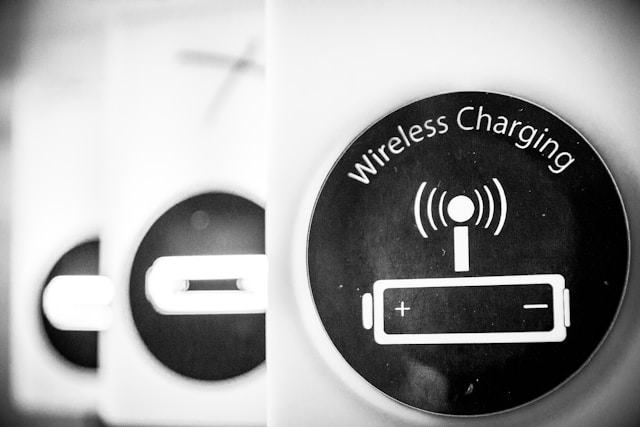
You place your phone on a small pad on your desk, walk away to make a coffee, and come back to find it charged — no cable, no plugging in, no fumbling around in the dark trying to find the right port. Wireless charging feels almost like magic. But it’s not magic at all — it’s a clever, elegant application of physics that scientists have understood for nearly two centuries. In this guide we explain exactly how wireless charging works, why it behaves the way it does, what the different types are, and whether it’s actually worth using over a regular cable.
What is Wireless Charging?
Wireless charging is a method of transferring electrical energy from a charging pad or stand to your device without any physical cable connection between them. Instead of electricity flowing through a wire from a plug into your phone, it’s transmitted through the air — or more precisely, through the thin gap between the charging surface and the back of your device — using electromagnetic fields.
The technology is also commonly known as inductive charging, and it works on the same fundamental principle as a transformer — the electrical component found in phone chargers, power adapters, and electricity substations that converts electrical energy from one form or voltage to another.
Most modern smartphones, wireless earbuds, and smartwatches support wireless charging. The dominant standard used across the industry is called Qi — pronounced “chee,” from the Chinese word for life energy — developed and maintained by the Wireless Power Consortium, an industry group whose members include Apple, Samsung, Google, and most other major consumer electronics manufacturers. If your device supports wireless charging, it almost certainly uses Qi.
How Does it Actually Work?
The science behind wireless charging is based on a principle called electromagnetic induction, first described by the scientist Michael Faraday in 1831. It sounds technical but the concept is actually quite elegant and intuitive once it’s explained clearly.
Inside your wireless charging pad there is a coil of copper wire. When electricity flows through this coil, it creates a magnetic field in the space immediately around it — this is a fundamental property of electrical current known as electromagnetism. The magnetic field extends outward from the coil, through the surface of the charging pad, and into the space immediately above it.
When you place your phone on the charging pad, the magnetic field produced by the pad’s coil passes through the back of your phone and reaches a second coil of wire inside your device. Here’s where the magic happens — a changing magnetic field passing through a wire coil induces an electrical current in that coil. This is Faraday’s law of electromagnetic induction. The current induced in your phone’s receiving coil is then processed by a small circuit in your phone and used to charge your battery.
Think of it like two tuning forks placed near each other. If you strike one tuning fork and hold it near another of the same frequency, the second one begins to vibrate — energy has been transferred through the air without any physical contact. Wireless charging works on an analogous principle, but with electromagnetic fields and electrical current instead of sound waves and mechanical vibration.
The two coils need to be in close proximity to each other — generally within a few millimetres — which is why your phone needs to be placed directly on or very near the charging pad surface rather than just somewhere nearby. The efficiency of energy transfer drops off rapidly with distance.
Why Does it Matter?
Wireless charging matters because it removes friction from one of the most repetitive and mundane tasks in modern life — keeping your devices charged. The average smartphone user charges their phone every single day. That’s 365 times a year that you’re plugging and unplugging a cable. Wireless charging turns that daily task into something you don’t have to think about at all — you simply put your phone down in one spot and it charges.
Beyond convenience, wireless charging has meaningful benefits for device longevity. The charging port is one of the most mechanically stressed components on a smartphone — it’s physically inserted and removed hundreds or thousands of times over the life of a device. Each connection introduces small amounts of mechanical wear. By reducing reliance on the physical port, wireless charging can extend its useful life and reduce one of the most common causes of smartphone damage.
For people who charge on a bedside table, desk, or kitchen counter, wireless charging pads can become genuinely seamless parts of the environment — surfaces where devices are simply placed and always found charged when needed, without any conscious effort.
The Different Types of Wireless Charging
Not all wireless charging is the same, and understanding the differences can help you make better decisions about which chargers and devices to choose.
Standard Qi wireless charging The most common type, supported by virtually all wirelessly charged consumer devices. Standard Qi charging operates at speeds between 5W and 15W depending on the charger and the device being charged. It’s widely compatible across different brands — a Qi charger designed for a Samsung phone will also charge an iPhone or any other Qi-compatible device, though not necessarily at maximum speed.
Manufacturer fast wireless charging Most major manufacturers have developed proprietary fast wireless charging systems that exceed standard Qi speeds. Apple’s MagSafe system for iPhone charges at up to 15W and uses a ring of magnets to ensure perfect alignment between the phone and the charger, maximising efficiency. Samsung’s fast wireless charging supports up to 15W on compatible Galaxy devices. Some Android manufacturers have pushed wireless charging speeds significantly higher — OnePlus and Xiaomi have demonstrated wireless charging systems operating at 50W, 65W, and even higher, though these require proprietary chargers to achieve those speeds.
Reverse wireless charging Some smartphones can function as wireless charging pads themselves, allowing you to charge other compatible devices by placing them on the back of your phone. This is useful for topping up wireless earbuds or helping a friend charge their device in a pinch, though it does drain your own battery in the process and the speeds are generally quite slow.
Multi-device wireless charging pads Some charging pads and stands are designed to charge multiple devices simultaneously — a smartphone, a smartwatch, and wireless earbuds all at once from a single pad. Apple’s MagSafe Duo and various third-party alternatives offer this multi-device capability, making them particularly convenient for people with multiple wireless-charging compatible devices.
Common Mistakes and Misconceptions
Misconception 1 — Wireless charging damages your battery faster than wired charging. This is a persistent myth that continues to circulate online despite being thoroughly disproven. Modern wireless charging systems include sophisticated battery management and protection features that regulate temperature, prevent overcharging, and maintain battery health. Used normally, wireless charging does not degrade your battery significantly faster than wired charging. The factors that genuinely harm lithium-ion batteries — extreme heat, consistently charging to 100% and discharging to 0%, and very fast charging repeatedly — apply equally to both wired and wireless methods.
Misconception 2 — Wireless charging works through any case. It doesn’t. The transmitting and receiving coils need to be within a few millimetres of each other. Very thick phone cases — particularly rugged cases designed for heavy-duty protection — can increase the gap between the coils enough to reduce charging efficiency or prevent charging altogether. Cases that contain metal components, metal plates, or credit cards with magnetic strips can also interfere with or completely block wireless charging. Standard slim cases in plastic, silicone, or leather are generally compatible without any issues.
Misconception 3 — All Qi chargers deliver the same speed. They don’t. While all Qi chargers are compatible with all Qi devices, the speed at which they charge varies significantly. A basic 5W Qi charger will charge a Samsung Galaxy phone much more slowly than Samsung’s own 15W fast wireless charger. For the best charging speed, use a charger certified for your specific device — particularly for Apple’s MagSafe fast charging and Samsung’s fast wireless charging.
Misconception 4 — Wireless charging is inefficient and wasteful. Wireless charging is slightly less energy efficient than wired charging because some energy is lost as heat during the electromagnetic transfer process. However the practical difference in your electricity consumption and energy bills is negligible — we’re talking about fractions of a penny per charge cycle. The convenience benefit for most people far outweighs this tiny inefficiency.
Frequently Asked Questions
Is wireless charging slower than wired charging? Generally yes, though the gap is closing. Standard wireless charging at 5-15W is slower than modern wired fast charging, which can deliver 30W, 65W, 100W or even higher on some devices and chargers. However for overnight charging or charging during a work session, the speed difference is largely irrelevant — your phone will be fully charged by the time you need it either way. Where wired charging has a clear advantage is in emergency top-up situations where you need significant battery percentage in a short amount of time.
Does wireless charging work with a phone case? Usually yes, provided the case isn’t too thick and doesn’t contain metal components. Standard slim cases in plastic, silicone, rubber, or genuine leather are typically compatible with wireless charging without any noticeable reduction in speed. Thick rugged cases, cases with built-in card holders containing metal cards, or cases with magnetic accessories attached may reduce or block wireless charging.
Can I use any wireless charger with my iPhone or Android phone? Any Qi-compatible charger will charge any Qi-compatible device — Apple, Samsung, Google, or otherwise. However to achieve the fastest charging speeds, you need a charger specifically certified for your device. Apple’s 15W MagSafe fast charging only works with MagSafe-certified chargers on compatible iPhones. Samsung’s fast wireless charging only reaches its maximum speed with Samsung’s own fast wireless chargers or certified third-party alternatives.
Does wireless charging use significantly more electricity than wired? The difference is real but very small in practice. Wireless charging has a slightly lower energy efficiency — typically around 80-85% versus 90-95% for wired charging — meaning a small additional amount of electricity is consumed per charge cycle, lost as heat. Over the course of a year of daily charging, this difference might amount to a few pennies worth of electricity. It’s environmentally and financially negligible for individual users.
Can I use my phone while it’s wirelessly charging? Yes — you can use your phone normally while it’s on a wireless charging pad, though picking it up and using it will obviously interrupt the charging. Some wireless charging stands hold the phone upright at an angle, making it easier to use while charging without breaking the connection.
The Bottom Line
Wireless charging works by using electromagnetic induction to transfer electrical energy between two coils — one in the charging pad and one inside your device — without any physical connection between them. The technology is mature, safe, and increasingly fast, with premium chargers now delivering speeds that are genuinely competitive with all but the fastest wired options. For everyday charging — overnight on a bedside table or during a workday on a desk — wireless charging is convenient enough to meaningfully improve your daily routine. If your device supports it and you don’t already have a wireless charger, it’s worth trying. The experience of simply placing your phone down and picking it up charged is one of those small quality-of-life improvements that turns out to matter more than you’d expect.