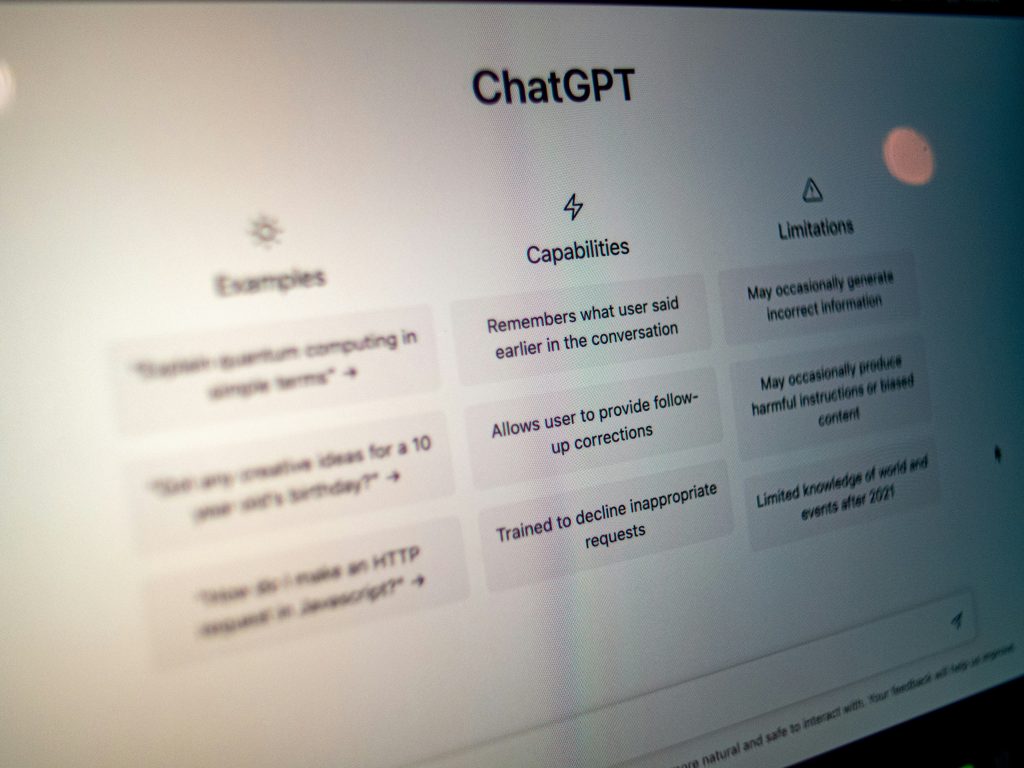
You’ve probably heard the name ChatGPT everywhere — on the news, from friends, maybe even from your boss. Everyone seems to be talking about it, using it, or arguing about it. But what exactly is it, and how does it actually work? In this guide we break it all down in plain English. No tech degree required, no confusing jargon — just a clear, honest explanation of one of the most talked-about technologies in years.
What is ChatGPT?
ChatGPT is an AI-powered chatbot created by a company called OpenAI. It was released to the public in November 2022 and quickly became one of the fastest-growing technology products in history, reaching 100 million users in just two months — faster than TikTok, faster than Instagram, faster than any consumer app before it.
At its core, ChatGPT is a program you can have a conversation with. You type a question or a request, and it responds in natural, human-like language almost instantly. You can ask it to explain a concept, write an email, summarise a long document, help debug code, brainstorm ideas, or just answer a question — and it does all of this in seconds.
Unlike a traditional search engine that gives you a list of links, ChatGPT gives you a direct answer in conversational language. That’s what makes it feel so different from anything people have used before.
How Does it Actually Work?
ChatGPT is built on a type of AI called a Large Language Model, or LLM. Without getting too technical, here’s the simple version of how it works.
It was trained on an enormous amount of text from the internet — books, articles, websites, academic papers, forums, and more. During this training process it learned patterns in language: how words relate to each other, how sentences are structured, how ideas connect, and how humans naturally communicate.
When you ask ChatGPT a question, it doesn’t search the internet for an answer in real time. Instead it draws on everything it learned during training to predict the most helpful and coherent response to your input.
Think of it like this — imagine someone who has read almost every book and article ever written, can recall and combine that information instantly, and can express it clearly in any style you ask for. That’s roughly what ChatGPT does, though it’s important to understand it doesn’t actually “think” the way humans do. It’s an incredibly sophisticated pattern-matching system, not a conscious mind.
Why Does it Matter?
ChatGPT matters because it fundamentally changes how people interact with computers and information. For decades, if you wanted information you typed keywords into a search engine and sifted through results. If you wanted to write something, you sat down and wrote it yourself. If you needed code, you either knew how to write it or hired someone who did.
ChatGPT collapses all of that. It gives everyone — regardless of technical skill, writing ability, or education — access to a powerful assistant that can help with almost any information-based task. That’s a genuinely significant shift in how people work, learn, and create.
What Can You Use ChatGPT For?
ChatGPT is surprisingly versatile. Here are some of the most common and useful ways people use it every day:
Writing help — drafting emails, essays, cover letters, social media posts, product descriptions, and more. You give it a brief and it produces a solid first draft in seconds.
Learning and research — explaining complex topics in simple terms, summarising long documents, answering follow-up questions until something clicks.
Coding assistance — writing code from scratch, explaining what existing code does, finding bugs, and suggesting fixes. This has been transformative for developers.
Brainstorming — generating ideas for businesses, creative projects, marketing campaigns, content calendars, and more.
Translation — converting text between languages with impressive accuracy.
Customer service scripts, legal document summaries, meal planning, travel itineraries — the list goes on. If it involves words and information, ChatGPT can probably help.
Common Mistakes and Misconceptions
Despite how impressive ChatGPT is, there are some important things people often get wrong about it.
Misconception 1 — ChatGPT is always accurate. It isn’t. ChatGPT can state incorrect information with complete confidence — a phenomenon called “hallucination.” It can make up facts, cite fake sources, and present wrong answers as though they’re correct. Always verify important information from a reliable source, especially for medical, legal, or financial matters.
Misconception 2 — ChatGPT knows what’s happening right now. The free version of ChatGPT has a knowledge cutoff date, meaning it doesn’t know about recent events. It’s not browsing the internet in real time unless you’re using a version with that feature enabled.
Misconception 3 — Using ChatGPT means you don’t need to think. The best results come when you engage with the output critically — edit it, improve it, fact-check it, and make it your own. Treating it as a first draft tool rather than a finished product generator will serve you much better.
Free vs Paid — What’s the Difference?
ChatGPT is available in both free and paid versions. The free version gives you access to GPT-3.5 which is capable and genuinely useful for everyday tasks. The paid version, ChatGPT Plus at $20 per month, gives you access to GPT-4 — significantly more powerful, better at reasoning, more accurate, and able to handle more complex tasks.
For casual everyday use the free version is perfectly fine to get started. If you find yourself using it heavily for work or complex tasks, the upgrade is worth considering.
There’s also ChatGPT for Teams and Enterprise versions designed for businesses, which include additional privacy protections and collaboration features.
Frequently Asked Questions
Is ChatGPT safe to use? Generally yes for everyday tasks. Avoid sharing sensitive personal information like passwords, financial details, or private medical information in your prompts. OpenAI uses conversation data to improve its models unless you opt out in your settings.
Can ChatGPT replace Google? Not entirely, but it’s already changing how many people search for information. ChatGPT gives direct answers while Google gives you sources. For many questions, a direct answer is more useful — but for current events, specific facts, or when you need to verify sources, Google still has the edge.
Is ChatGPT going to take people’s jobs? Some jobs will change significantly as AI becomes more capable. Jobs that involve repetitive writing, basic coding, or information processing are most affected. However most experts agree that AI is more likely to change how jobs are done than eliminate them entirely — at least in the near term.
Does ChatGPT remember our previous conversations? By default, ChatGPT does not retain memory between separate conversations. Each new chat starts fresh. There is a memory feature available in some versions that can be enabled if you want it to remember things about you across sessions.
How Do I Start Using It?
Getting started with ChatGPT is simple and takes less than two minutes:
Go to chat.openai.com and create a free account using your email address or Google account. Once you’re logged in, just type your first question or request into the chat box and press enter. That’s it — no downloads, no complex setup, no technical knowledge required.
Start with something simple like asking it to explain a concept you’ve always been curious about, or ask it to help you write an email you’ve been putting off. The best way to understand what it can do is to just start using it.
The Bottom Line
ChatGPT is one of the most genuinely useful AI tools available to everyday people right now. Whether you want to learn something faster, get help with writing, or just explore what AI can do, it’s worth spending fifteen minutes trying it out. Just remember to think critically about the answers it gives you — it’s a powerful tool, but like any tool, it works best when used thoughtfully.